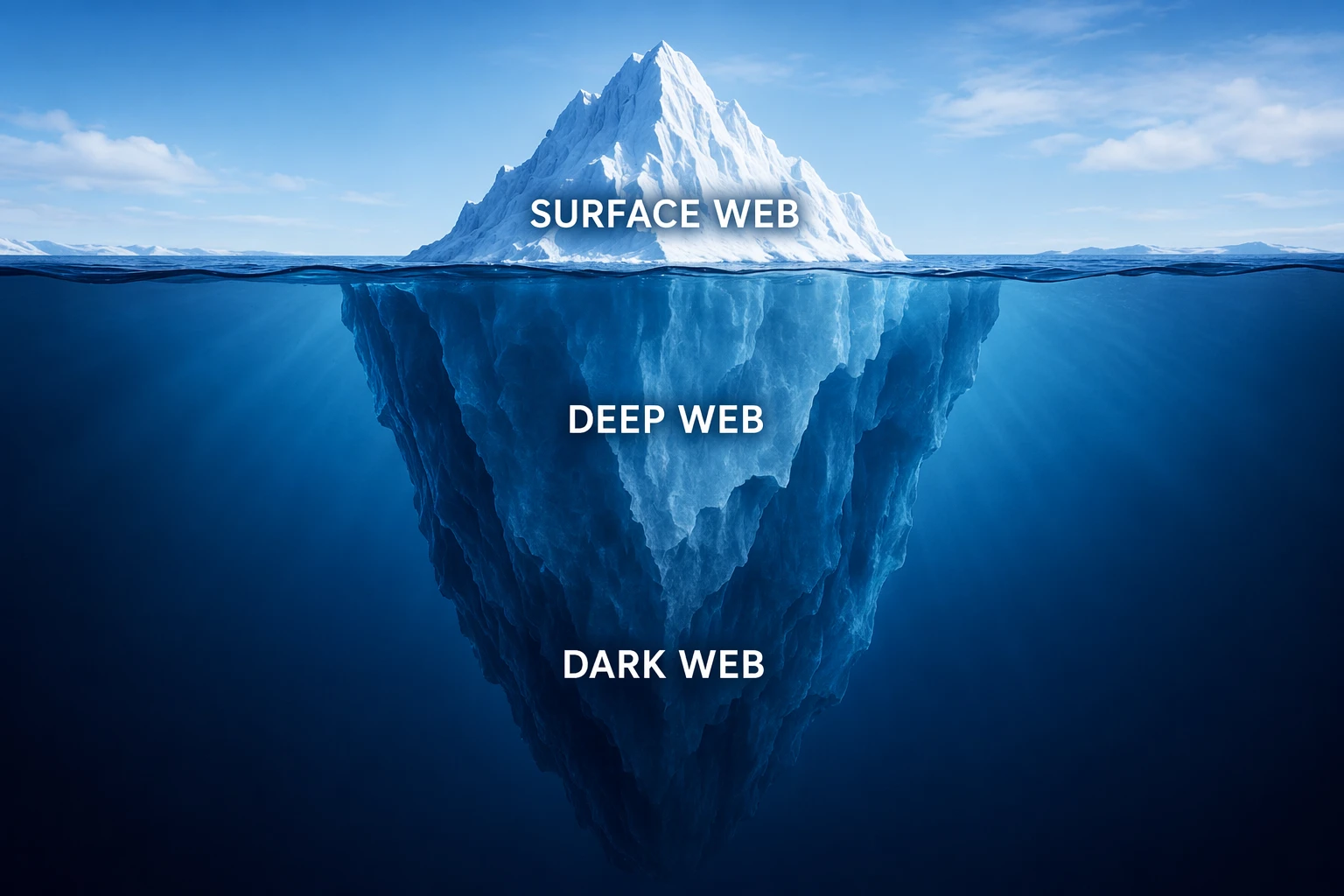
When most people think about the internet, they imagine Google searches, online shopping, news websites, Teams meetings and social media. But that everyday experience is only a small part of a much bigger picture. The hidden layers of the web help explain why the internet feels endless – and why understanding it matters for security, awareness and good decision-making.
The public-facing web is enormous on its own, with estimates suggesting there are now over 1 billion websites online, while around 6 billion people are using the internet globally in 2025. But even those headline numbers only tell part of the story. A great deal of online content sits outside search engine results, behind logins, paywalls, databases and internal systems.
For businesses, that matters. If your team assumes that “the internet” is only what appears in Google, they may underestimate both the scale of online risk and the importance of protecting company data properly. Understanding the hidden layers of the web is a useful reminder that the visible internet is only the tip of the iceberg.
What are the hidden layers of the web?
A simple way to think about the web is in three broad layers:
1. The Surface Web
The Surface Web is the portion of the web that search engines can index and display publicly. That includes company websites, online news, public product pages, blogs and most of the content people browse every day. The indexed web alone was estimated at nearly 4 billion pages in early 2025, though researchers note that this is still only a minimum estimate of what search engines can actually see.
2. The Deep Web
The Deep Web is not sinister by default – it simply refers to content that is not publicly indexed by search engines. That includes Microsoft 365 files, customer portals, CRM systems, academic databases, private dashboards, banking pages and medical records. Researchers and commentators commonly describe this as the largest section of the web, even though exact percentages vary and should be treated as broad estimates rather than precise measurements.
3. The Dark Web
The Dark Web is a much smaller part of the Deep Web that requires specific software or configurations to access. It often gets the headlines because it can be used for criminal activity, but that is not its only use case. It has also historically been used by journalists, activists and people trying to avoid censorship. The key point for most businesses is this: stolen credentials, leaked data and phishing kits can all circulate in places most everyday users never see directly.
How small is the everyday web really?
This is where the topic gets interesting.
People often quote that the Surface Web is only a small fraction of the wider web, while everything else sits beneath it. The exact percentages vary depending on the method used, and nobody can measure the full web with perfect accuracy because so much of it is private, dynamic or inaccessible to public crawlers.
What we can say with confidence is that:
- the public web is vast, with more than 1 billion websites online by recent counts, yet only a minority are actively maintained and updated.
- search engines only index part of what exists. Even the indexed web estimate of nearly 4 billion pages is described as a lower-bound estimate, not a full census of everything online.
- much of the most valuable business information on the internet is intentionally not public – because it sits in cloud platforms, internal systems, secured databases and subscription tools.
So while people like to joke that the internet is “just memes and shopping”, the reality is that most of the web is made up of hidden systems, private content and machine-accessed data that everyday users never browse directly.
A brief history of web growth
The growth of the internet over the last few decades has been staggering.
In 1995, only around 39 million people were online globally. By 2000, that figure had climbed to roughly 361 million. By 2005, it was around 1 billion, and by 2025, internet use had reached approximately 5.6 to 6 billion people, depending on the source and measurement date.
That growth reflects a huge combination of factors:
- cheaper smartphones
- better global connectivity
- cloud computing
- mobile apps
- social media
- streaming
- digital business platforms
- better access to broadband and mobile data services
At the same time, the number of websites also exploded. The web crossed the 1 billion website milestone years ago, and estimates in 2025-2026 place the total number somewhere between roughly 1.1 billion and 1.38 billion, depending on methodology. Importantly, only around 15-17% of those sites appear to be actively maintained.
That means the internet is not just growing – it is also becoming more cluttered, more automated, and in many cases harder to trust at face value.
How AI could shape the next phase of the web
AI is already changing how people use the web – and not just by helping them write emails or summarise documents.
Search itself is shifting. Studies published in 2025 and 2026 show that AI-driven discovery is growing quickly, with one major analysis reporting 527% growth in AI-sourced traffic year-on-year, while another found 796% growth in generative AI traffic across a large dataset from 2024 to 2025.
That matters because AI may increase web growth in two different ways:
AI may increase the amount of content online
Generative AI lowers the barrier to creating articles, landing pages, product descriptions, FAQs and support content. In simple terms, more people and businesses can now produce more web content, more quickly. That could make the public web even larger – but also noisier.
AI may reduce clicks to traditional websites
At the same time, AI assistants and AI-generated search summaries are starting to answer questions directly, without always sending users through to a website. Research into AI Overviews and zero-click search behaviour suggests this is already changing traffic patterns and the way publishers think about visibility.
So the future web may become:
- larger in raw content volume
- more machine-generated
- more summarised by AI
- less dependent on traditional search result clicks
- more competitive for credibility and attention
In other words, AI is unlikely to shrink the internet. It is more likely to reshape how content is created, discovered and trusted.
Why this matters for everyday businesses
This is not just an interesting technology fact. It has practical consequences for SMEs.
If the web is far bigger than most users realise, and AI is making information even easier to generate and harder to verify, then your people need to be more careful about what they click, trust and share.
That includes:
- treating unexpected login pages with caution
- checking links and sender details before entering credentials
- remembering that not all convincing content is trustworthy
- understanding that leaked company information may circulate well beyond public websites
- keeping business systems properly secured, monitored and updated
The hidden layers of the web are not something most staff need to explore in technical detail – but they are useful for building awareness. Once people understand that the visible web is only one small part of a much bigger digital environment, security advice tends to make a lot more sense.
Practical reminders for staying safe on the surface web
Here are a few simple reminders worth sharing internally:
- Use strong, unique passwords – especially for Microsoft 365, finance platforms and admin accounts.
- Turn on multi-factor authentication wherever possible.
- Be cautious with links and attachments, even if a page or message looks polished.
- Keep sensitive information off public platforms unless there is a clear business reason and proper controls in place.
- Train users regularly, because awareness is still one of the best defences against phishing and social engineering.
Most threats your users encounter will arrive via the ordinary, everyday web – email links, fake login pages, malicious downloads or impersonation attempts. That is why secure habits on the surface web still matter so much.
Final thoughts
The modern internet is astonishingly large, but the part most people interact with each day is only one layer of a much broader online world. The hidden layers of the web include private systems, secured data, internal platforms and harder-to-access networks that most users never see – yet those hidden layers often hold the information that matters most.
Add AI to the mix, and the web is set to become even bigger, faster and more complex. That makes digital awareness more important, not less. Businesses do not need to become experts in every corner of the internet – but they do need to understand that what is visible on the surface is only part of the story.
If you would like help improving your security posture, user awareness or Microsoft 365 protections, Core Team One can help you put sensible safeguards in place without making life harder for your users.