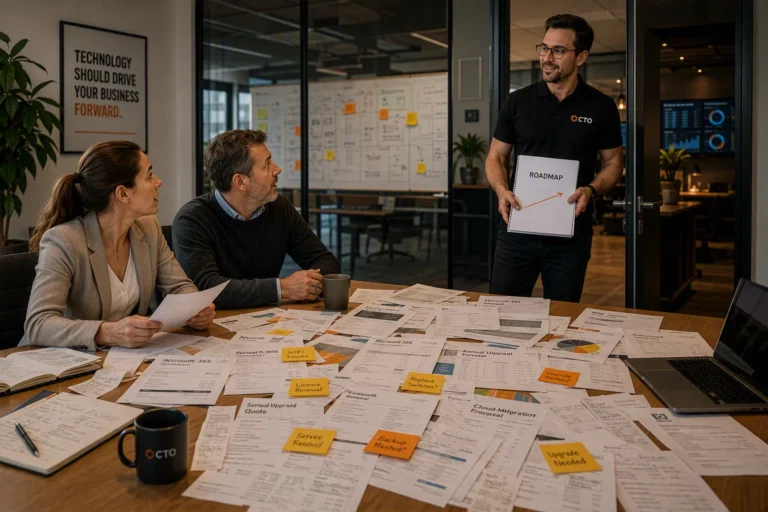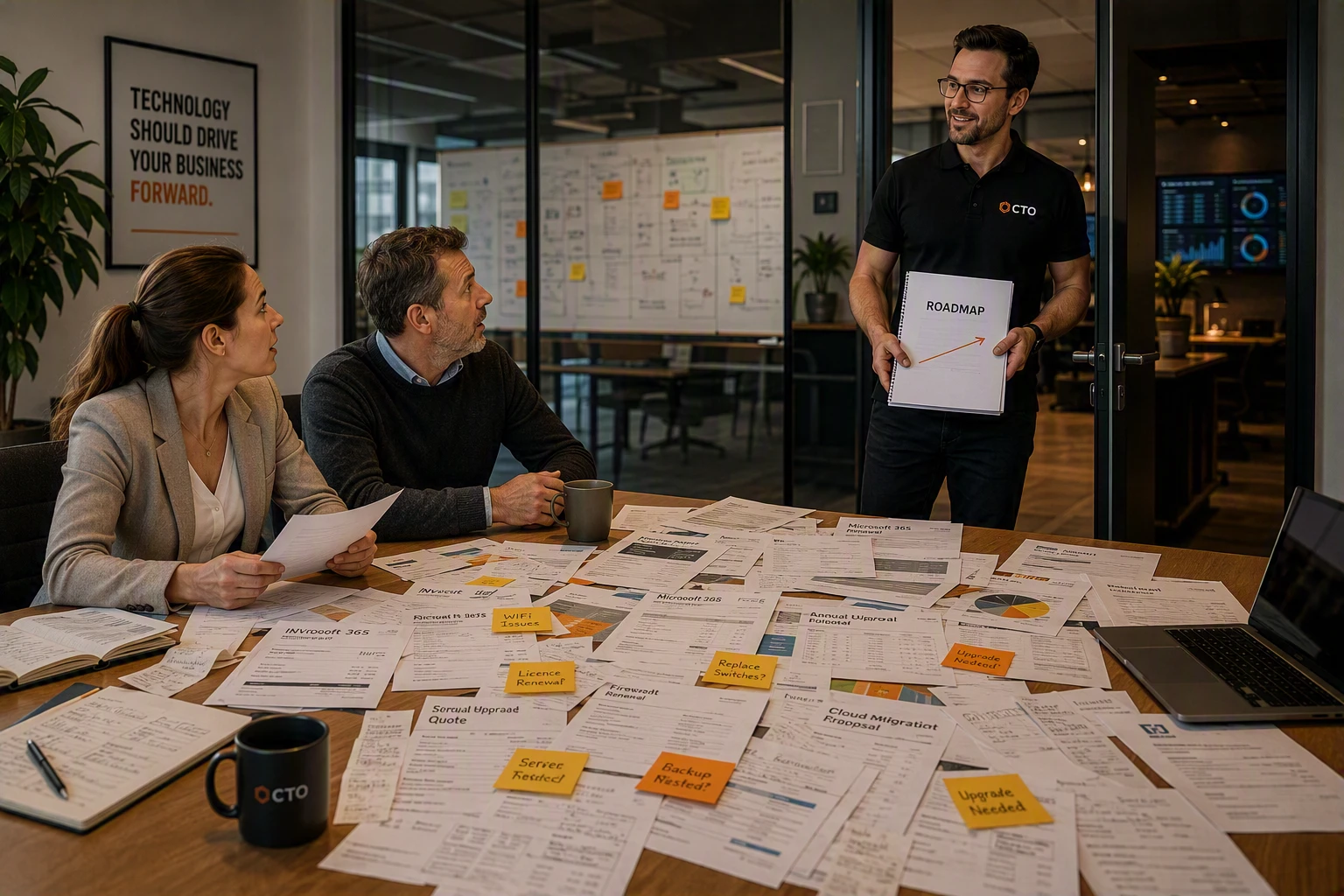
Let’s start with an uncomfortable truth about SME IT strategy – Most SMEs don’t have an IT strategy.
They think they do. They have a collection of software subscriptions, a few ageing servers, some laptops, a cyber security product and an IT support provider.
That’s not a strategy. That’s just technology.
A strategy should answer a simple question:
How is technology going to help the business achieve its goals over the next three to five years?
For many organisations, that conversation never happens.
Instead, technology decisions are made one problem at a time:
- The server fails or support ends, so it gets replaced.
- The WiFi struggles, so more access points get installed.
- A cyber attack appears in the news, so additional security software gets purchased.
Every decision may be reasonable in isolation, but together they create something dangerous: an IT estate with no clear direction.
Replacing Things When They Break Isn’t a Strategy
Imagine running your vehicle fleet without knowing when any of the vehicles needed servicing or replacing.
Most business owners would consider that reckless. Yet many businesses treat their technology exactly this way.
Laptops are replaced when they become unusable. Servers remain in production long after support has ended. Network equipment stays untouched until it causes an outage.
The result is entirely predictable:
- Unexpected costs.
- Unexpected downtime.
- Unexpected risk.
A real SME IT strategy plans these investments years in advance. It removes surprises and allows technology spending to become predictable rather than reactive.
Cyber Security Is Not an IT Strategy
This is perhaps the biggest misconception we see today.
Cyber security is critically important. But cyber security alone is not a strategy.
In recent years, many organisations have become focused almost exclusively on security, and understandably so. The threats are real and growing.
However, secure systems that are poorly documented, unsupported, underperforming or unable to scale with the business are still a risk.
Technology strategy should consider:
- Security
- Infrastructure
- Cloud services
- Business continuity
- Disaster recovery
- Connectivity
- Device lifecycle management
- User productivity
- Future business growth
Security is a vital component, but it is only one piece of the puzzle.
A Spreadsheet of Assets Isn’t a Strategy Either
We occasionally encounter businesses that proudly produce a hardware inventory and describe it as their IT roadmap.
An asset register is useful. Knowing what you own is important. But a list of devices tells you where you are today. It tells you nothing about where you’re going next.
A strategy should define:
- What technology needs replacing and when
- Which business systems require investment
- Where cloud services fit into future plans
- How security maturity will improve over time
- What budget will be required to support growth
Without those answers, a business is simply reacting to events as they occur.
Hope Is Not a Business Strategy
Perhaps the harshest truth of all.
Many SME technology environments operate on hope.
- Hope the server lasts another year.
- Hope the backup works.
- Hope the internet doesn’t fail.
- Hope the cyber criminals target someone else.
- Hope the old software keeps running.
Hope is not a strategy. It never has been.
The organisations that consistently outperform their competitors are usually not spending more on technology. They’re planning better.
They understand where they want the business to go and ensure that technology supports that journey.
The Question Every SME Should Be Asking
Forget the products. Don’t think about the vendors. Ignore the endless marketing noise.
Ask a simpler question:
Do we actually have a documented technology strategy that supports our business objectives?
If the answer is no, then that is probably the biggest technology risk facing the organisation today.
Not because your systems are failing, but because nobody has defined where they’re supposed to be heading.
Final Thoughts
Technology should never be a collection of disconnected purchases made over a period of years.
It should be a deliberate, planned investment that supports growth, improves resilience and helps the business achieve its goals.
If your current IT strategy consists of replacing things when they break and hoping for the best, the good news is that you’re not alone. The bad news is that it isn’t a strategy – it’s just hope.
At Core Team One, we help organisations build practical technology roadmaps that align IT investment with business goals. If you’d like an independent review of your current environment and a clearer plan for the future, we’d be happy to start the conversation.