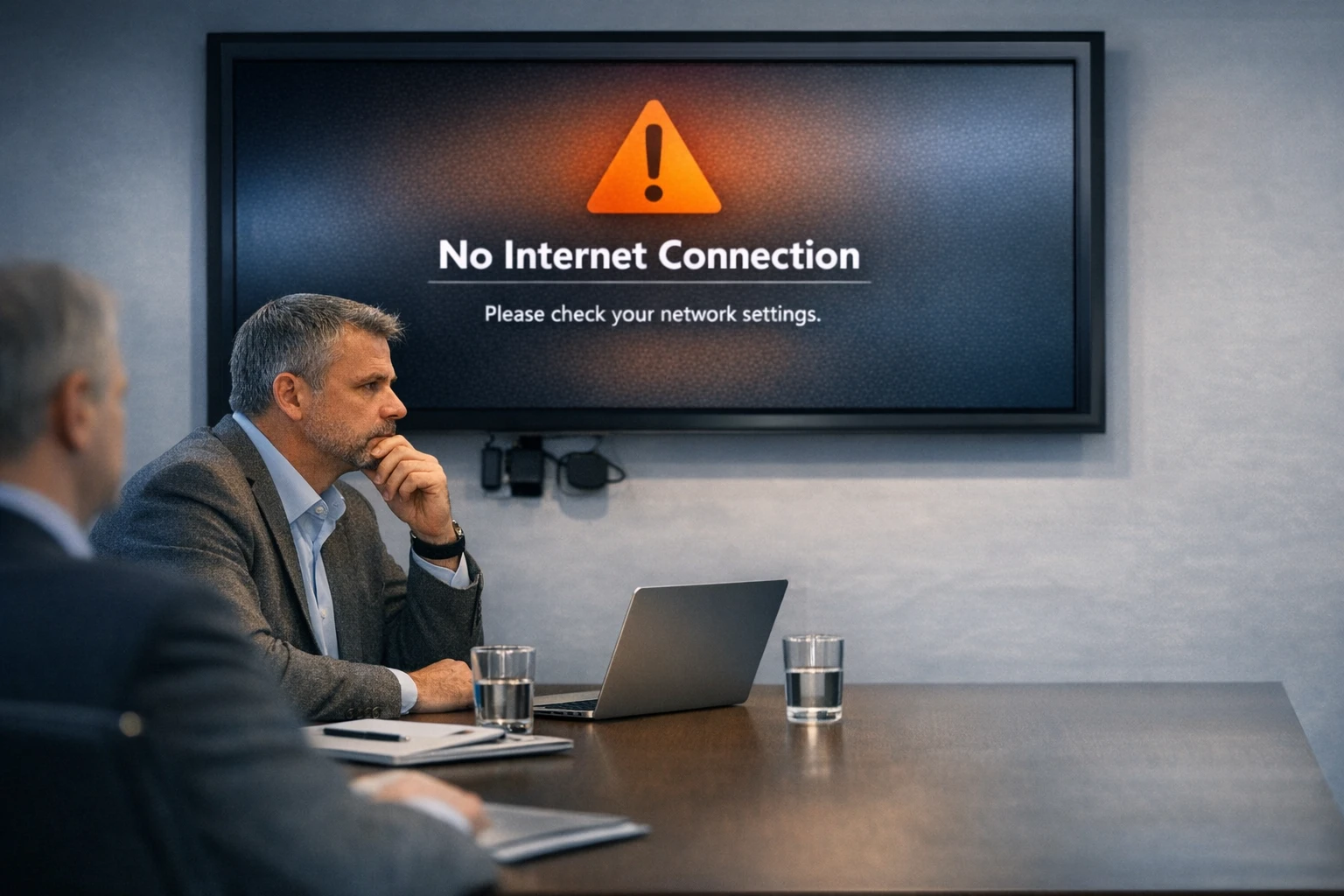
SME internet resilience has quietly become one of the most critical factors in business continuity.
For years, connectivity sat firmly in the “IT problem” category.
If it went down, staff made a brew, IT called the provider, and business carried on – eventually.
That world no longer exists. Today, your internet connection powers:
- Cloud platforms like Microsoft 365
- VoIP phone systems
- Remote working
- Customer portals and e-commerce
- Cyber security monitoring and controls
If your internet goes down, your business stops.
That’s why SME internet resilience is now a board-level issue – not just an IT one.
The Hidden Risk: Single Points of Failure
Many organisations still rely on a single circuit. Even if it’s fast or marketed as “business-grade”, it still represents a single point of failure.
The reality is:
- Fibre circuits get cut
- Exchanges fail
- ISPs have outages
- Local infrastructure goes down
Without proper SME internet resilience, even a short outage can bring operations to a halt.
What Good Looks Like: Multi-Line Resilience
True SME internet resilience isn’t about buying the most expensive line – it’s about removing risk through design.
That means:
- Multiple connections
- Different technologies
- Automatic failover
At Core Team One, the principle is simple: Avoid single points of failure wherever possible.
CTO’s Preferred Resilience Model
Where possible, we recommend combining:
- Primary: Business-grade Ethernet
- Secondary: A different technology on a different network (e.g. FTTP broadband or 4G/5G)
Why this approach strengthens SME internet resilience
✅ Reduced shared failure risk
Using different carriers and technologies reduces the chance of a single incident taking everything offline.
✅ Clear separation of responsibility
Issues can be identified and escalated more quickly when services are independent.
✅ Cost-effective resilience
Two premium Ethernet lines purely for backup are rarely necessary. A mixed approach delivers strong SME internet resilience at a more sensible cost.
Failover Is Critical – But So Is Intelligent Design
Having multiple lines is only half the story. To achieve proper SME internet resilience, traffic needs to be managed intelligently.
At CTO, we typically terminate connections into a Fortinet Next-Generation Firewall (NGFW), enabling:
- Active/active connectivity – both lines in use
- Intelligent load balancing and SD-WAN
- Near-instant failover
- Session-aware traffic handling
This ensures:
- No wasted backup line
- Better everyday performance
- Minimal disruption when a circuit fails
Done properly, failover becomes invisible to end users.
Testing: The Missing Piece in SME Internet Resilience
One of the biggest gaps we see is lack of testing. A failover solution that hasn’t been tested is not resilience – it’s assumption.
We recommend:
- Quarterly failover testing as a minimum
- Simulated outages
- Validation of key systems during failover
If you’re serious about SME internet resilience, this step is non-negotiable.
Security and Resilience Must Work Together
Connectivity resilience and security are tightly linked. Your firewall is now a critical control point, which is why we also recommend:
- External penetration testing
- Continuous monitoring
- Proper inspection and policy configuration
Strong SME internet resilience keeps the business running. Security ensures it stays protected while it does.
Industrial and Rural Limitations
It’s important to acknowledge a real-world constraint.
In many industrial estates and rural areas, high-speed broadband like FTTP is simply not available, often due to infrastructure rollout decisions.
This can limit options for SME internet resilience, meaning:
- 4G/5G or Satalite may be the only viable backup
- Bandwidth may be constrained
- More bespoke solutions are required
In these environments, design becomes even more important.
The Bottom Line
SME internet resilience is no longer about having “a backup line”.
It’s about:
- Eliminating single points of failure
- Mixing technologies and providers
- Implementing intelligent failover
- Testing regularly
- Securing the perimeter
Most importantly, it’s about recognising that internet downtime is a business risk.
For advice and guidance, visit the UK National Cyber Security Centre (NCSC) guidance on resilience and risk management here: https://www.ncsc.gov.uk/guidance
How Core Team One Can Help
At Core Team One, we design and support SME internet resilience solutions that keep businesses online when it matters most.
From multi-line connectivity and Fortinet deployments to failover testing and security assessments, we help you stay operational, secure, and in control.
👉 Want to review your current setup? Get in touch for a no-obligation internet resilience assessment.